
Top 10 Aluminum Casement Window Manufacturers
Choosing among the Top 10 Aluminum Casement Window Manufacturers is not just a branding exercise. Buyers need to compare frame design, thermal breaks, glazing options, hardware, finish durability, and service support. Small details matter. A sash that closes poorly can weaken an otherwise strong specification.
The U.S. Department of Energy’s Energy Saver guidance reports that heat gain and loss through windows account for 25%–30% of residential heating and cooling energy use. That figure covers windows generally, not aluminum casement units alone; it is a useful benchmark, not a product rating. Building scientist Joseph Lstiburek of Building Science Corporation offers a stark reminder: “Windows are holes in the wall.” Memorable, but incomplete. The quote cannot tell us which manufacturer seals, drains, or supports a unit best.
This guide compares manufacturers using practical criteria: published performance data, tested configurations, fabrication quality, warranty terms, and regional availability. Ask for ratings tied to the exact size, glass package, and hardware being quoted. A catalog number is not enough. Casement designs can offer broad ventilation and tight compression seals, but results depend on installation and maintenance. Coastal exposure, wind-driven rain, and frequent operation can reveal weaknesses quickly. Look closely at corners, hinges, locking points, and drainage paths. Some rankings make the decision seem simpler than it is. Public data are uneven, and manufacturers do not always report comparable tests. That limitation deserves attention. The strongest choice is not automatically the most expensive or widely advertised. It is the unit whose documented performance fits the building, climate, budget, and installer’s skill. Use the following list as a shortlist, then verify specifications directly with each manufacturer.
Understanding Aluminum Casement Windows and Their Key Features
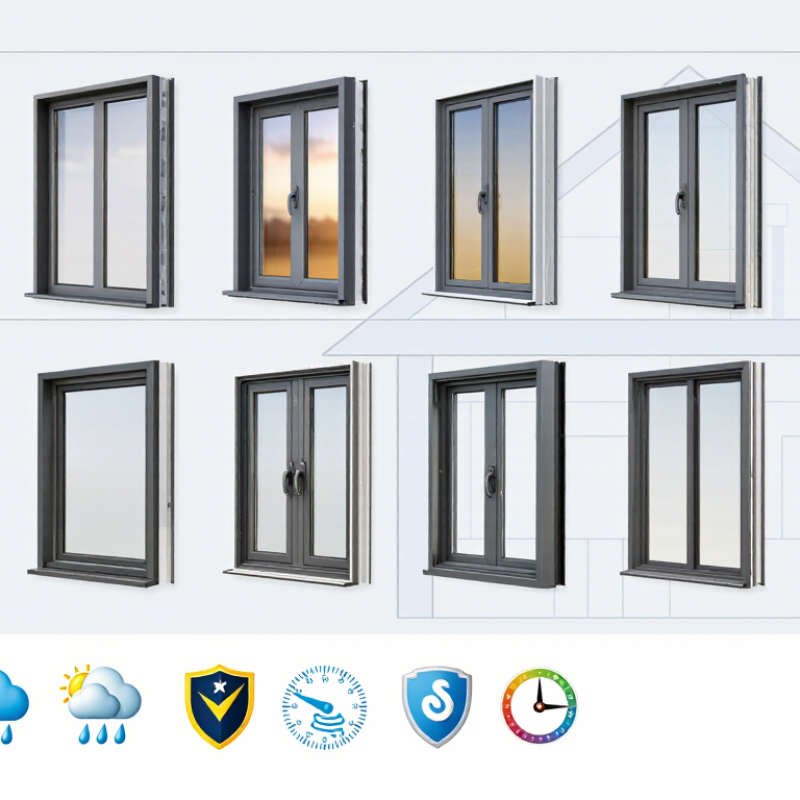
Aluminum casement windows hinge at the side and open outward, bringing in fresh air when weather permits. Their narrow frames can preserve a clear view, while a multipoint lock can pull the sash firmly against its seals. Aluminum is strong, but it also conducts heat readily. A thermal break separates the inner and outer frame sections, reducing that transfer. It helps, but does not make every window equally efficient.
The U.S. Department of Energy’s Energy Saver guidance estimates that heat gain and loss through windows account for about 25–30% of residential heating and cooling energy use. That national estimate varies with climate, glazing, installation, and household use. For a real comparison, check a tested unit’s U-factor and solar heat gain coefficient, not frame appearance alone. The National Fenestration Rating Council provides standardized ratings for these measures. There is a trade-off. Wider glass areas may brighten a room, yet increase solar gain or heat loss if glazing is poorly chosen. I find hardware easy to overlook: hinges and locks must support the sash smoothly, especially on large openings. Even a well-rated window can underperform if the frame is out of square or the perimeter seal is uneven. A small draft can be telling.
Top 10 Aluminum Casement Window Manufacturers - Understanding Aluminum Casement Windows and Their Key Features
Feature-based guide to aluminum casement windows. Specifications vary by product, size, glazing, and market; confirm performance ratings for the exact configuration being considered.
| No. | Feature | Typical construction or specification | Why it matters | What to check |
|---|---|---|---|---|
| 1 | Casement operation | The sash is hinged at the side and operated with a handle or crank; opening direction depends on the design. | Allows the sash to open wide for ventilation and can direct airflow into a room. | Confirm hinge side, opening direction, hardware position, and clearance from nearby walls or walkways. |
| 2 | Aluminum frame | Aluminum profiles form the frame and sash; profile depth and internal design vary by product. | Aluminum is lightweight relative to its strength and can support slim frame sightlines. | Review frame dimensions, structural documentation, and the visible frame width for the chosen size. |
| 3 | Thermal break | Thermally improved frames use a low-conductivity barrier between interior and exterior aluminum sections. | Reduces heat transfer through the frame compared with a non-thermally broken frame. | Ask whether the frame is thermally broken and compare whole-window thermal ratings, not frame descriptions alone. |
| 4 | Glazing options | Available configurations can include single, double, or triple glazing, with glass coatings or gas-filled cavities depending on the product. | Glass selection affects insulation, solar heat gain, visible light, and sound reduction. | Check the complete glazing build-up and certified whole-window U-factor and solar heat gain coefficient (SHGC), where available. |
| 5 | Weather seals | Gaskets and weatherstripping are fitted around contact points between the sash and frame. | Properly designed and maintained seals help limit air and water entry when the window is closed. | Review air-leakage and water-penetration test results for the relevant window configuration. |
| 6 | Hardware and locking | Hinges, an operator, and one or more locking points are used; hardware layouts differ by design and size. | Hardware supports sash movement, closure, and engagement with the frame. | Check operation, adjustment access, corrosion suitability for the location, and availability of replacement parts. |
| 7 | Air leakage performance | Air leakage is measured through testing under a stated method and pressure; results are product-specific. | A lower reported leakage value indicates less air passing through the tested window under the test conditions. | Compare values using the same test method, units, and product size where possible. |
| 8 | Water and wind performance | Test ratings depend on the complete window assembly, dimensions, glazing, hardware, and installation details. | Relevant ratings help assess suitability for local exposure and building requirements. | Request documented water-penetration and structural-pressure results for the intended size and application. |
| 9 | Surface finish | Common aluminum finishes include anodized surfaces and factory-applied paint coatings, including powder-coated finishes. | Finish affects appearance and surface protection; suitability depends on the environment and maintenance. | Check the finish specification, care instructions, warranty terms, and suitability for coastal or industrial conditions. |
| 10 | Installation and drainage | The frame must be installed plumb, level, and square; drainage paths and flashing details are part of the opening assembly. | Correct installation helps the window operate as designed and directs incidental water away from the building interior. | Follow the product installation instructions and coordinate sill drainage, flashing, and wall-system details. |