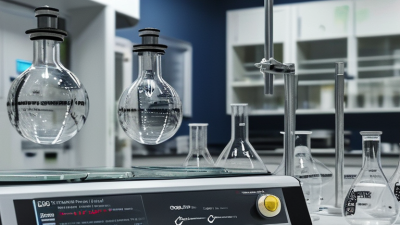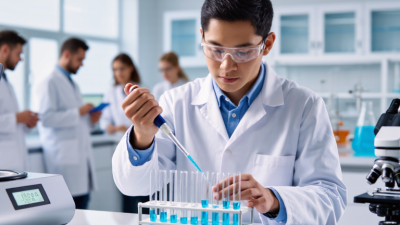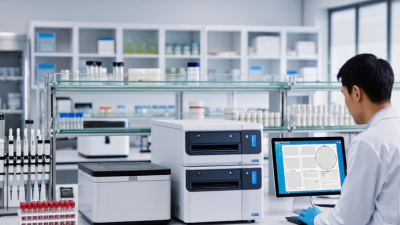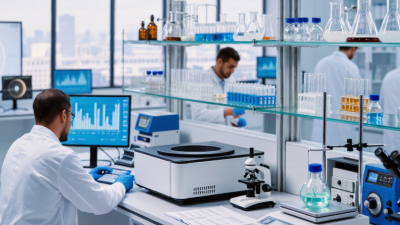
Scientific Equipment is entering 2026 under strong pressure to become faster, smarter, and easier to validate. Laboratories now need reliable results, not impressive specifications alone. Analytical instruments, molecular biology platforms, advanced microscopes, automated liquid handlers, and laboratory information systems are likely to attract the greatest attention. Environmental monitoring equipment also matters, especially where water quality, air safety, and climate research overlap.
Industry evidence supports this direction. The OECD’s Main Science and Technology Indicators show continuing global investment in research and development, although growth differs sharply between regions. The UNESCO Science Report highlights expanding demand for research infrastructure, digital tools, and stronger laboratory capacity. Market analysis from Grand View Research and MarketsandMarkets also points toward sustained growth in life science instrumentation, analytical technologies, laboratory automation, and informatics through the decade. These reports use different methods, so their forecasts should not be treated as identical facts.
Practical performance will separate valuable equipment from expensive clutter. A mass spectrometer must deliver stable sensitivity across long runs. A microscope should produce clear images without demanding constant manual adjustment. An automated workstation needs accurate pipetting, simple maintenance, and dependable software integration. Small details matter: calibration records, replacement-part availability, cleaning time, and training requirements can decide whether a system succeeds.
The ranking will not be universal. A pharmaceutical laboratory may prioritize high-throughput chromatography, while a university may value modular microscopes and shared instruments. Forecasts can miss sudden funding changes, supply disruptions, or new standards. That uncertainty deserves attention. This guide compares the leading Scientific Equipment types for 2026 through capability, adoption, operating practicality, and evidence from recognized industry and public-sector reports.
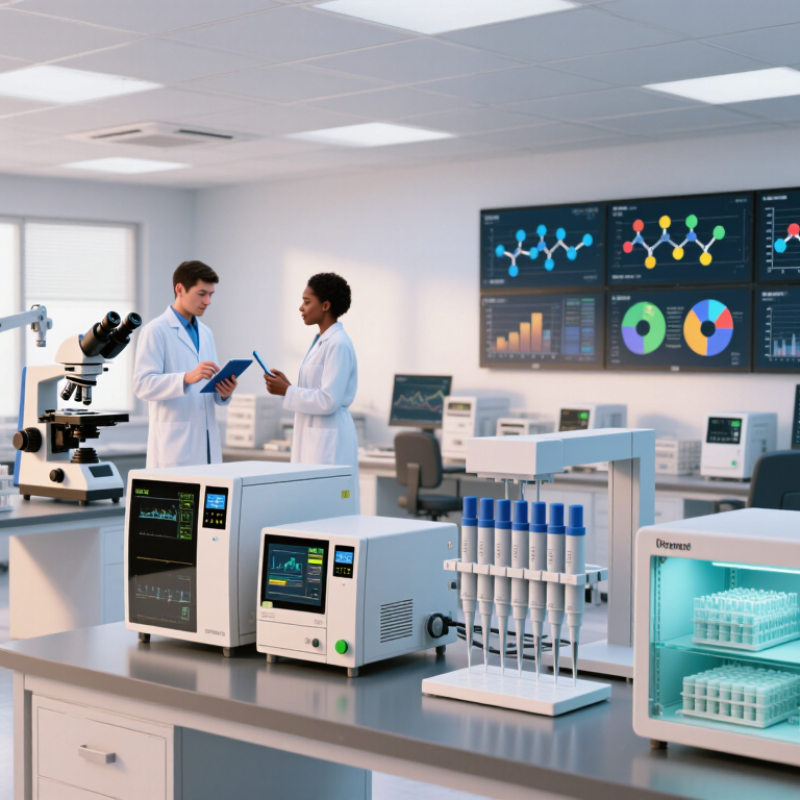
Scientific equipment is the collection of tools used to observe, measure, test, and control conditions in research. Its scope ranges from simple glassware and balances to imaging systems, analytical instruments, sensors, and data-processing equipment. A balance can reveal tiny changes in sample mass; a microscope can show structures invisible to the eye. Small details matter.
In modern research, equipment turns questions into observations that can be compared and repeated. Temperature-controlled chambers help keep experiments consistent, while spectrometers and other analytical instruments examine what samples contain. Sensors can track changes over time, and computing systems help researchers organize and interpret results. Tools support research; they do not replace careful judgment.
Reliable work depends on more than choosing advanced equipment. Researchers need suitable methods, trained operators, routine maintenance, and records of calibration and settings. A clean reading can still mislead if a sensor is poorly positioned or a sample is contaminated. This is easy to overlook. Equipment also has limits: measurement ranges, detection thresholds, and environmental sensitivities can shape what a study is able to claim. Good practice means reporting those limits, even when the result feels less tidy.
Selecting scientific equipment for 2026 means judging performance beyond the specification sheet. The U.S. Department of Energy’s Better Buildings guidance notes that laboratories can use five to ten times more energy per square foot than typical offices. That makes power consumption, heat output, and standby settings practical buying criteria. A freezer or incubator that runs continuously can quietly raise both operating costs and room temperature. Check capacity under real workloads, not just the maximum listed by the supplier. That matters.
Accuracy also needs evidence. Review calibration intervals, measurement uncertainty, service availability, and whether data can be exported with timestamps and audit trails. NIST guidance on metrological traceability and ISO/IEC 17025 requirements offer useful benchmarks for checking measurement quality and calibration records. Ask how long replacement parts typically take to arrive, and whether routine maintenance requires specialist support. I still find lifetime cost harder to compare than purchase price. Energy use, consumables, downtime, and calibration can change the calculation. A useful evaluation records those assumptions beside each model, then tests the shortlisted equipment with representative samples. Specifications help, but actual workflow fit can expose inconvenient trade-offs.
What Are the Top Scientific Equipment Types for 2026?
Top Scientific Equipment Types Across Major Research Fields
Scientific equipment choices in 2026 still depend on the question, sample, and working conditions. In life sciences, microscopes reveal cell structure, while centrifuges and thermal cyclers support sample preparation and analysis. Small details matter. A microscope with strong resolution may still be a poor fit if its images are difficult to compare across experiments.
Chemistry labs commonly use chromatographs and spectrometers to separate and identify compounds. Physics teams rely on oscilloscopes, precision sensors, and data-acquisition systems to measure fast or faint signals. Earth and environmental researchers need field meters and sampling equipment that can handle changing temperatures, dust, and moisture. No single instrument does everything. Even advanced equipment can produce misleading results if calibration, sample handling, or operator training is overlooked. That part is easy to underestimate.
Tips: Match the instrument to sample size, throughput, and required accuracy. Check calibration records, service needs, and data-export options before purchase. If possible, test representative samples first; real workflows can expose awkward steps that a product sheet misses. Keep a little room for revision, too. Research methods change, and equipment that looks ideal today may need careful reassessment later.
| Research Field | Scientific Equipment Type | What It Measures or Does | Common Research Uses | Key Selection Considerations |
|---|---|---|---|---|
| Cell Biology and Neuroscience | Confocal Laser-Scanning Microscope | Collects optical sections to create images with reduced out-of-focus light. | Imaging fluorescently labeled cells, tissues, and three-dimensional specimens. | Consider optical resolution, available excitation wavelengths, detector sensitivity, and sample photobleaching. |
| Materials Science and Nanotechnology | Scanning Electron Microscope (SEM) | Scans a focused electron beam across a specimen to reveal surface structure and composition-related contrast. | Examining surface morphology, particles, fractures, and microfabricated materials. | Check achievable resolution, sample dimensions, vacuum requirements, and whether elemental analysis is needed. |
| Structural Biology | Cryogenic Transmission Electron Microscope (Cryo-EM) | Uses electrons to image rapidly frozen specimens, often enabling reconstruction of molecular structures. | Studying purified macromolecules, viruses, and cellular structures. | Plan for specialized sample preparation, stable cryogenic handling, image-processing capacity, and facility access. |
| Chemistry and Metabolomics | Liquid Chromatography–Mass Spectrometry (LC-MS) | Separates compounds by liquid chromatography and measures ions by their mass-to-charge ratios. | Identifying and quantifying small molecules, metabolites, peptides, and contaminants. | Match the separation method, ionization approach, mass range, sensitivity, and sample throughput to the analytes. |
| Analytical Chemistry and Proteomics | Nuclear Magnetic Resonance (NMR) Spectrometer | Measures signals from nuclei in a magnetic field to provide information about molecular structure and chemical environment. | Determining molecular structures, studying molecular interactions, and analyzing mixtures. | Consider magnetic-field strength, probe type, sample amount, solvent compatibility, and access to specialist support. |
| Genomics and Molecular Biology | Next-Generation Sequencing System | Reads DNA or RNA-derived sequences in parallel to generate large numbers of sequence reads. | Genome and transcriptome studies, targeted panels, and microbial sequencing. | Evaluate read length, output per run, library-preparation needs, turnaround time, and downstream computing requirements. |
| Molecular Diagnostics and Gene Expression | Real-Time PCR (qPCR) System | Monitors amplification signals during PCR cycles to estimate the amount of target nucleic acid. | Gene-expression analysis, pathogen detection, and nucleic-acid quantification. | Check fluorescence channels, temperature uniformity, reaction format, assay validation, and controls for contamination. |
| Immunology and Cell Analysis | Flow Cytometer | Measures light scattering and fluorescence from individual cells or particles as they pass through a fluid stream. | Cell counting, immunophenotyping, cell-cycle analysis, and assessment of cell viability. | Match lasers and detectors to the fluorophores, and consider sample preparation, compensation, and throughput needs. |
| Geology, Chemistry, and Materials Research | X-Ray Diffraction (XRD) System | Measures X-ray diffraction patterns that can reveal crystalline phases and structural properties. | Identifying crystalline compounds and assessing phase composition or crystallinity. | Consider sample form, measurement geometry, phase-identification needs, and the required angular range. |
| Environmental Science and Trace Analysis | Inductively Coupled Plasma Mass Spectrometer (ICP-MS) | Measures elemental ions by mass after samples are introduced into a high-temperature plasma. | Trace-element analysis in water, soil, biological samples, and materials. | Account for detection limits, matrix effects, sample digestion, contamination control, and relevant interference correction. |
| Biochemistry and Chemical Biology | UV-Visible Spectrophotometer | Measures how much ultraviolet or visible light a sample absorbs at selected wavelengths. | Estimating concentration, monitoring enzyme reactions, and recording absorption spectra. | Choose a suitable wavelength range, optical path length, measurement format, and sensitivity for the sample. |
Scientific equipment development in 2026 is being shaped less by one breakthrough than by better integration. Imaging systems pair sharper detectors with software that flags unusual structures. Analytical instruments increasingly link rapid measurements to clearer data trails. Faster is useful, but only when results remain reproducible.
Automation is moving beyond robotic sample handling. Bench-top systems can coordinate pipetting, temperature control, and timed readings, reducing repetitive steps in busy laboratories. Yet automated workflows still need human checks: a poorly prepared sample can produce a precise-looking error. That matters. Microscopes and diagnostic instruments are also gaining easier-to-use interfaces, though simplified screens cannot replace proper training.
Connected sensors can track temperature, vibration, and humidity around sensitive equipment, helping staff spot problems before measurements drift. Modular designs may let laboratories replace a detector or upgrade software without replacing an entire instrument. This could reduce downtime, but compatibility between components is not always smooth. Not every lab needs the newest features. Researchers should judge equipment by calibration stability, maintenance demands, data quality, and how well it fits actual workflows—not by automation alone. Sometimes the less impressive machine is the more dependable one.
What Are the Top Scientific Equipment Types for 2026?
Selecting the Right Equipment for Specific Research Objectives
Choosing scientific equipment works best when the research question leads the decision. A microscope suits imaging cells or materials, while a spectrometer can identify compounds by measuring how they interact with light. Chromatography systems help separate complex mixtures. Environmental chambers maintain controlled temperature and humidity for stability studies. Fit comes first.
Before comparing models, define the sample, measurement range, required precision, and expected daily workload. A balance with excellent resolution may still be unsuitable if samples are unstable or the room vibrates. Check whether the instrument fits existing benches, power supplies, ventilation, and data systems. Ask how often calibration is needed, and who will perform it. A lower purchase price can hide demanding maintenance or training costs. It is easy to overbuy.
Tips: Write down three must-have measurements before requesting quotes. Test representative samples when possible, not just convenient standards. Confirm service access and consumable availability. Keep time for staff training; a sophisticated instrument can produce weak data when users are rushed. Revisit the criteria after testing. The first list is rarely perfect.
For imaging research, choose equipment based on the smallest features you need to resolve and the kind of sample you are studying.
Representative spatial resolution values are approximate; actual performance depends on the instrument, setup, and sample. Lower values indicate finer detail. Widefield and confocal microscopes suit many cell and tissue studies; scanning and transmission electron microscopes are used when finer structural detail is needed.