
How to Source Research Equipment Worldwide?
How to Source Research Equipment Worldwide? This question now reaches beyond finding the lowest price. It involves technical fit, supplier credibility, delivery risk, and long-term support. UNESCO’s 2021 Science Report shows that global research and development investment increased steadily during the previous decade. That expansion has strengthened demand for reliable laboratory instruments, testing systems, imaging devices, and measurement tools.
The right Research Equipment may be a centrifuge, spectrometer, microscope, or environmental chamber. Each item requires a different sourcing strategy. The OECD Main Science and Technology Indicators emphasize major differences in national research capacity and business investment. These differences affect supplier networks, technical support, and replacement-part availability. The World Bank’s Logistics Performance Index 2023 also evaluates customs, infrastructure, shipment quality, and delivery timeliness. Those factors matter when equipment crosses borders.
Small details create expensive problems. A freezer may require 230-volt power, local certification, and continuous temperature monitoring. A microscope may arrive safely but lack regional service engineers. Buyers should verify calibration records, warranty terms, software compatibility, installation requirements, and total landed cost. ISO/IEC 17025 accreditation can strengthen confidence in calibration and testing services, although it does not guarantee every purchasing outcome.
No report captures every supplier failure. Real procurement still requires careful verification. A polished website is not proof of technical competence. Buyers should request reference installations, inspect documentation, and confirm response times before ordering. Procurement teams may also compare new, refurbished, and locally supported options. The cheapest quotation can become the costliest decision. Careful sourcing makes global research more dependable, transparent, and resilient.
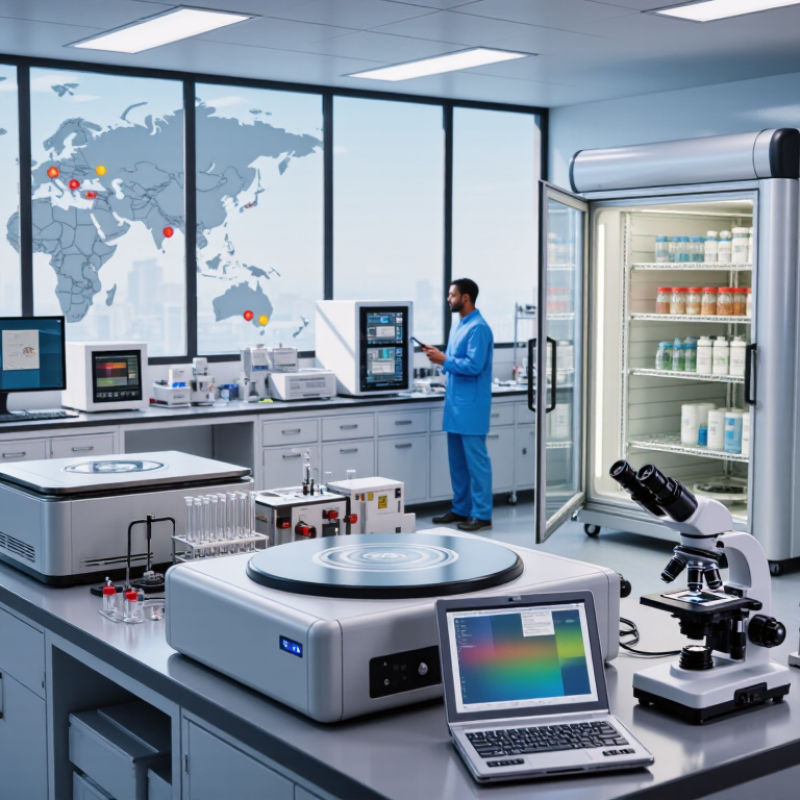
Define Research Equipment Requirements and Technical Specifications
How to Source Research Equipment Worldwide?
Clear technical requirements prevent expensive sourcing mistakes. Start with the research objective, not a catalog image. Describe the measurement range, accuracy, resolution, sample capacity, and operating temperature. Include material compatibility and environmental limits. A device handling corrosive samples may need sealed surfaces and specialized internal materials.
Define power requirements carefully. Specify voltage, frequency, plug configuration, and backup needs. Add software compatibility, data formats, communication ports, and cybersecurity expectations. Calibration details also matter. Request traceable calibration certificates, uncertainty data, service intervals, and acceptance-test procedures. Ask suppliers to provide drawings, manuals, test reports, and realistic delivery conditions. In practice, a spreadsheet can still miss installation space. Measure door widths, bench depth, ventilation routes, and lifting access. Small oversights become costly.
Tips: Write requirements as measurable statements. Replace “high precision” with a maximum error value. Separate essential features from preferred features. Ask two independent technical reviewers to challenge the specification. I often leave a short review period before approval. It feels slower, but it exposes vague assumptions. Compare total ownership costs, including training, calibration, consumables, customs handling, and local service. Do not accept copied specifications without verification. Request a sample report or demonstration using a comparable workload. The final requirement should let different suppliers quote against the same technical target.
How to Source Research Equipment Worldwide? - Define Research Equipment Requirements and Technical Specifications
| Equipment Category | Typical Research Application | Key Technical Specifications | Recommended Requirement Definition | Relevant Standards or Compliance Areas | Sourcing and Verification Checklist |
|---|---|---|---|---|---|
| Analytical Balance | Precise weighing of powders, chemicals, samples, and calibration materials. | Readability: 0.1 mg; capacity: approximately 200–320 g; repeatability: typically ≤0.1 mg; internal or external calibration; draft-shield enclosure. | Specify minimum readability, maximum load, repeatability, pan size, stabilization time, calibration method, and operating temperature range. | Laboratory weighing procedures; electrical safety; electromagnetic compatibility; calibration traceability to recognized national or international standards. | Request a calibration certificate, repeatability test results, environmental requirements, power compatibility, user interface language, and service support details. |
| Laboratory Centrifuge | Separation of cells, particles, precipitates, blood components, and suspended materials. | Maximum speed: approximately 4,000–20,000 rpm; relative centrifugal force determined by rotor radius; rotor capacity: commonly 1.5 mL to 500 mL per position; programmable time and acceleration. | Define tube format, rotor type, maximum g-force, speed accuracy, temperature control, imbalance detection, noise limit, and safety-lock requirements. | Electrical safety, mechanical safety, containment requirements, laboratory biosafety procedures, and applicable electromagnetic compatibility requirements. | Confirm rotor compatibility, replacement availability, balancing instructions, lid-lock performance, vibration levels, and international voltage configuration. |
| Laboratory Freezer | Long-term storage of biological samples, reagents, enzymes, and temperature-sensitive materials. | Setpoint range: commonly −20 °C or −80 °C, depending on application; temperature uniformity and recovery time; usable volume; alarm system; data logging. | Define required temperature, allowable fluctuation, storage volume, door configuration, backup power, alarm contacts, data-export format, and ambient operating range. | Refrigeration safety, electrical safety, refrigerant regulations, energy requirements, laboratory cold-chain procedures, and local import regulations. | Request temperature-mapping data, alarm test records, power-consumption data, refrigerant information, spare-parts plan, and delivery conditions for temperature-sensitive equipment. |
| UV–Visible Spectrophotometer | Absorbance and transmittance measurements for chemical, biological, and material analysis. | Wavelength range: commonly about 190–1,100 nm; wavelength accuracy; photometric range; spectral bandwidth; cuvette path length; stray-light performance. | Specify wavelength range, optical resolution, measurement modes, sample-holder type, baseline correction, software functions, and required detection limits. | Optical-performance verification, electrical safety, electromagnetic compatibility, data-integrity controls, and laboratory calibration procedures. | Request wavelength and photometric accuracy reports, validation procedures, software licensing terms, cuvette compatibility, and exportable raw-data formats. |
| pH / Conductivity Meter | Measurement of acidity, alkalinity, ionic conductivity, and total dissolved solids in liquid samples. | pH range: commonly 0–14; pH resolution: 0.01 or 0.001; temperature compensation; conductivity range based on probe; calibration with certified reference solutions. | Define measurement range, accuracy, resolution, sample temperature, probe type, calibration points, IP protection, and data-recording requirements. | Electrode storage and calibration procedures; electrical safety; chemical compatibility; traceability of reference buffers and conductivity standards. | Verify probe replacement cost, buffer compatibility, calibration certificate, temperature sensor accuracy, cable length, and maintenance requirements. |
| Thermal Cycler | Controlled temperature cycling for nucleic-acid amplification and molecular biology protocols. | Block format: commonly 96 wells; temperature range: approximately 4–100 °C; temperature uniformity; ramp rate; heated-lid control; programmable cycle memory. | Specify tube or plate format, block capacity, temperature accuracy, uniformity, ramp rate, gradient function, program storage, and software export options. | Electrical safety, electromagnetic compatibility, laboratory molecular-biology quality procedures, and contamination-control requirements. | Request temperature-validation data, compatible consumable dimensions, firmware and software support policy, calibration interval, and remote-service capability. |
| Digital Microscope | Inspection and imaging of cells, surfaces, particles, fibers, and prepared specimens. | Optical magnification: commonly 40×–1,000×; numerical aperture; camera resolution; illumination type; field of view; mechanical stage travel. | Define specimen type, magnification range, resolution target, illumination method, camera interface, image format, measurement accuracy, and required accessories. | Optical calibration, electrical safety, laser or high-intensity-light safety where applicable, and laboratory imaging documentation procedures. | Check calibration-slide results, software compatibility, camera drivers, replacement-light availability, vibration sensitivity, and packaging protection during international shipment. |
| Fume Hood | Control of hazardous vapors, aerosols, and airborne contaminants during chemical handling. | Face velocity commonly specified around 0.4–0.6 m/s, subject to local requirements; sash opening; internal width; airflow alarm; exhaust connection; chemical-resistant work surface. | Define chemical types, required face velocity, sash position, exhaust volume, duct material, filtration or ducted configuration, noise limit, and installation space. | Local laboratory ventilation codes, worker-safety requirements, electrical safety, fire-safety provisions, and chemical-resistance specifications. | Require airflow-certification data, factory acceptance criteria, installation drawings, duct requirements, site commissioning, and maintenance access information. |
| Precision Environmental Chamber | Controlled testing of samples under defined temperature, humidity, and lighting conditions. | Temperature range depends on design; humidity control commonly approximately 20–95% relative humidity; uniformity; stability; chamber volume; programmable profiles. | Specify temperature and humidity ranges, stability and uniformity limits, recovery time, lighting requirements, access ports, data logging, and maximum sample load. | Environmental testing procedures, electrical safety, refrigeration safety, humidity-measurement calibration, and local energy requirements. | Request chamber mapping, sensor calibration records, condensate-management details, shipping dimensions, installation clearance, and on-site qualification support. |
| Data Acquisition System | Recording temperature, pressure, force, voltage, current, flow, and other experimental signals. | Channel count; input type; sampling rate; resolution commonly 16–24 bit for precision applications; signal conditioning; isolation; storage and communication interfaces. | Define sensor types, channel quantity, sampling frequency, accuracy, synchronization, trigger method, file format, network requirements, and cybersecurity controls. | Electrical safety, electromagnetic compatibility, calibration traceability, data-integrity procedures, and applicable measurement-system requirements. | Verify sensor compatibility, calibration inputs, software operating-system support, API availability, time-stamping accuracy, warranty terms, and replacement-module lead times. |
Related Posts
-
What Are the Top Scientific Equipment Types for 2026?
-

Why Is Research Lab Equipment Essential for Global Buyers?
-
Why Choose Reliable Research Lab Equipment Suppliers?
-

What Is Scientific Lab Equipment Used For?
-
10 Tips for Buying Scientific Lab Equipment
-
Why Choose Lab Equipment for Your Global Laboratory Needs?